Watercolor Flowers Mouse Clipart PNG for Designers and Creatives
There’s something immediately disarming about a watercolor flower rendered in soft, bleeding pigment, especially when you pair it with a tiny mouse character peeking out from behind a petal. Watercolor Flowers Mouse Clipart PNG offers exactly that blend of botanical delicacy and playful charm. It sits at an intersection where fine art meets whimsy, and that combination is surprisingly versatile across commercial, editorial, and personal projects. If you’ve been looking for design assets that feel handmade without requiring you to actually pick up a brush, this clipart set deserves a close look.
Visual Personality and Stylistic Appeal
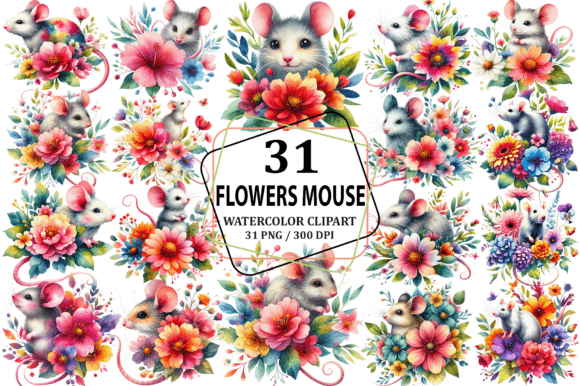
The first thing you notice is the wash effect. These aren’t flat, vectorized flowers with hard edges and uniform color. The watercolor treatment gives each bloom a translucent quality—pigment pools at the edges, fades toward the center, and occasionally bleeds into adjacent petals. That organic imperfection is exactly what makes Watercolor Flowers Mouse Clipart PNG feel tactile and approachable. The mouse characters, drawn in a similar hand-rendered style, avoid looking cartoonish. Instead, they carry a gentle, almost storybook quality. Tiny whiskers, rounded ears, and soft shading keep them from tipping into childish territory. They look like they wandered in from a children’s book illustration, which is precisely the vibe that works for so many warm, personable brand identities.
The color palette typically leans toward blush pinks, lavender, sage green, dusty rose, and butter yellow. These muted tones make the set easy to layer without clashing. You won’t find neon brights or jarring contrasts. Everything is intentionally soft, which gives you room to pair it with stronger typography or bolder graphic elements without visual chaos. The PNG format is a practical bonus here—transparent backgrounds let you drop these elements directly onto patterned paper, textured cardstock, or digital layouts without cutting or masking time.
Where This Clipart Shines Across Projects
The sweet spot for Watercolor Flowers Mouse Clipart PNG is any project that needs warmth, approachability, and a handcrafted feel. Branding for small businesses like nurseries, children’s boutiques, organic skincare lines, and stationery shops benefits enormously from this style. A logo built around one of these mouse-and-flower combinations instantly signals gentle, trustworthy, and artisanal. Wedding invitations, save-the-dates, and bridal shower stationery also borrow well from this aesthetic. The watercolor blooms read as romantic without being fussy, and the mouse characters add a subtle whimsical note that many couples are looking for in modern invitation design.
Editorial work is another strong fit. Think lifestyle magazines, parenting blogs, or gardening publications that want to soften a layout without resorting to stock photography. A full-page spread with a muted background, a single watercolor rose cluster in the corner, and a tiny mouse peeking from the margin creates a visual resting point for readers. Social media graphics—especially Instagram posts, Pinterest pins, and Facebook story templates—benefit from the high-quality, transparent PNG format. You can overlay text directly onto the flowers or position a mouse character as a brand mascot alongside your call-to-action. Package design is also worth mentioning. Soap wraps, candle labels, tea tin packaging, and gift tags all feel elevated when you use watercolor floral art instead of generic patterns. The mouse characters give the packaging a collectible, keepsake quality that customers are more likely to hold onto and photograph for social sharing.
Digital products like ebook covers, course slide decks, and website hero images also work well. Because the clipart is already rendered in PNG with transparency, you avoid the typical hassle of background removal. You can layer these elements directly into Canva, Photoshop, Procreate, or Affinity Designer and immediately see how they interact with your layout. For content creators who produce printables—planners, wall art, greeting cards, and journal kits—this set offers a consistent visual language across an entire product line without requiring you to commission custom illustrations each time.
How Design Assets Influence Visual Hierarchy and Brand Perception
When you introduce hand-painted floral elements into a layout, you are making a deliberate choice about visual hierarchy. The soft gradients and irregular edges of watercolor naturally draw the eye because they mimic the way we look at real objects—slowly, with attention to detail. In Watercolor Flowers Mouse Clipart PNG, the contrast between the delicate flowers and the more defined mouse characters creates a natural focal hierarchy. Viewers tend to look at the mouse first (it has a face, after all) and then let their gaze wander across the floral frame. That sequence of attention is useful for designers who want to guide a viewer toward a specific message or call-to-action without using aggressive arrows or bold typography.
Brand perception also shifts when you use watercolor art. Unlike geometric shapes or rigid vectors, watercolor communicates warmth, craftsmanship, and emotional intelligence. A brand built around these floral mouse assets signals that it values beauty, gentleness, and quality over mass production. That distinction matters in crowded markets. Skincare brands, for example, often compete on trust. A visual identity built with watercolor flowers suggests natural ingredients and careful formulation before a customer even reads the label. Similarly, a children’s brand that uses mouse characters suggests stories, bedtime, and safety. The consistency of using the same clipart style across your website, packaging, social media, and print materials reinforces brand recognition in a quiet but effective way.
Professionalism comes from how you integrate the assets, not from how polished the original art appears. A common mistake designers make is dropping watercolor clipart onto a sterile white background without any supporting texture. The result looks disconnected. The better approach is to use textured or tinted backgrounds—cream, kraft paper, soft gray, or pastel gradients—that already harmonize with the watercolor wash. When the background matches the paper-like quality of the art, the entire composition feels intentional and finished. Watercolor Flowers Mouse Clipart PNG works best when you let its organic edges breathe, so avoid tight cropping that cuts off the painted margins.
Choosing and Using This Clipart for Real Projects
Before you purchase or download a clipart set, evaluate your actual project requirements. If you are designing a logo, you need high-resolution files that scale cleanly. Look for PNG versions at 300 DPI or higher. The watercolor texture can become pixelated if you scale it too large from a low-resolution source, so check the dimensions before you commit. Also consider whether you need specific flower varieties. Some sets focus on roses and peonies, while others include wildflowers, lavender, daisies, or tulips. Match the floral content to your brand’s industry and tone. A wedding suite might want romantic roses. A nature blog might prefer wildflowers and ferns.
Testing Watercolor Flowers Mouse Clipart PNG in context matters more than previewing it on a white screen. Drop the elements into a mockup of your actual layout—a business card template, a website header, a product label—and see how they interact with your chosen typeface. Hand-painted florals pair well with modern serif fonts like Cormorant Garamond, Playfair Display, or Lora for a refined look. Sans serif options like Montserrat, Poppins, or Nunito offer a clean contrast that keeps the overall design from feeling overly ornate. Script fonts can work, but be careful: two organic elements competing for attention (watercolor art plus swirly script) can muddy your visual hierarchy. If you use a script, keep the text minimal and give it plenty of breathing room.
Readability is a legitimate concern when you layer text over watercolor clipart. The transparent nature of the PNG format means the underlying art can show through lighter colors, making white or pastel text difficult to read. A practical fix is to add a subtle drop shadow, a semi-transparent overlay, or a solid text box behind your copy. Alternatively, position your text on a clean area of the layout and let the clipart act as a framing device rather than a text background. For social media graphics, try placing your headline on the left third of the canvas and positioning the floral mouse art on the right third. That asymmetry feels contemporary and leaves enough negative space for your message to land.
Commercial licensing is the final checkpoint you cannot skip. Many clipart sets, including premium ones, differentiate between personal use, small business use, and full commercial use. If you plan to sell products that include the clipart—printed greeting cards, digital templates, or branded merchandise—read the license terms carefully. Some sets prohibit redistribution of the raw files, meaning your customers cannot extract the individual PNG elements. Others cap the number of products you can produce. Watercolor Flowers Mouse Clipart PNG from reputable marketplaces usually offers a standard commercial license that covers most small to medium production runs. When in doubt, contact the creator directly and get written confirmation. That one step protects your business from legal headaches down the road and respects the illustrator’s work.
Think about consistency across your entire project. If you use Watercolor Flowers Mouse Clipart PNG on your website hero, your product packaging should echo the same color palette and character style. A mismatch between your digital presence and physical products weakens brand recognition. Create a simple brand board that includes the primary flower colors, the mouse character poses, and a shortlist of complementary typefaces. Refer to that board every time you create a new asset. Over time, your audience will associate that watercolor floral aesthetic with your brand specifically, which is exactly how design assets build long-term recognition. The clipart is the starting point, but your consistent application of it turns a generic resource into something distinctly yours.