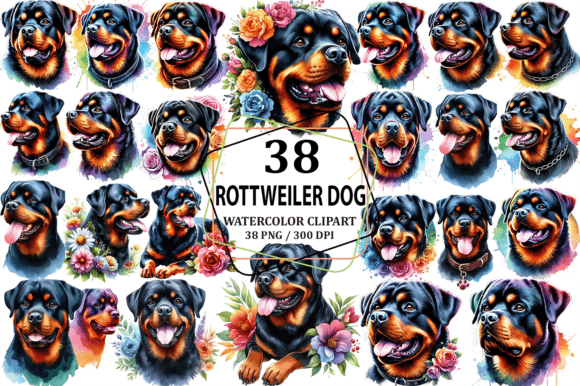
Watercolor Rottweiler Dog Clipart PNG
If you have ever tried to find dog artwork that balances strength with warmth, you know how rare that combination truly is. Most Rottweiler illustrations lean either too fierce or too cute. The Watercolor Rottweiler Dog Clipart PNG sits in a sweet spot between those extremes. It captures the breed's confident structure while softening the edges with painterly washes, subtle color bleeds, and a handcrafted feel that digital-only vectors often lack. This is not a stiff silhouette or a cartoon mascot. It is a design asset that feels alive, textured, and emotionally accessible.
For anyone building brands, creating content, or crafting personal projects, understanding what this clipart offers—and where it truly shines—can save you hours of searching for the right visual voice. Let's walk through its personality, practical applications, and how to evaluate whether it fits your next project.
What Makes Watercolor Rottweiler Dog Clipart PNG Distinctive
Watercolor clipart sits in a category of its own. Unlike flat vector icons or hyper-realistic photography, watercolor art brings an organic, human quality to the screen or page. With this Rottweiler clipart, you will notice several defining traits:
- Soft edges and natural gradients. The paint-like transitions between dark browns, blacks, and lighter tan markings create depth without harsh lines. This makes the dog feel approachable rather than aggressive.
- Expressive but controlled composition. Good watercolor clipart keeps the subject recognizable. The Rottweiler's broad head, sturdy stance, and characteristic markings remain clear even when the paint bleeds outside strict boundaries.
- Transparent PNG format. You get a ready-to-use asset with no background. Place it on a white page, a dark header, or a patterned paper, and the watercolor edges blend naturally without awkward white boxes.
- Handcrafted texture. Every brush stroke variation, every granulation in the pigment, adds a layer of authenticity. In a world of mass-produced templates, this kind of organic imperfection reads as genuine and thoughtful.
These qualities make the Watercolor Rottweiler Dog Clipart PNG more than just a picture of a dog. It becomes a design element that communicates personality, care, and a certain artistic sensibility before a single word is read.
Where This Clipart Delivers Real Value
Not every project needs watercolor art. But when the goal is to connect with an audience on a human level, this style often outperforms colder alternatives. Here are the spaces where I have seen it work best.
Brand Identity and Logo Design
Small businesses centered around pets, dog training, pet sitting, or animal-related products benefit from a logo that feels personal. A watercolor Rottweiler communicates warmth and trust. Pair it with a clean sans serif font for a modern brand identity, or a handwritten script font if the brand leans toward artisan or boutique positioning. The clipart's texture adds character without overpowering the typography.
One observation from working with pet brands: logos that feel too polished sometimes fail to build immediate emotional trust. Watercolor clipart, by contrast, suggests a real person made this. That matters when your audience is choosing who to trust with their dog.
Social Media Graphics and Content Creation
Instagram posts, Pinterest pins, Facebook covers, and YouTube thumbnails all compete for attention in crowded feeds. A flat stock photo often gets scrolled past. A watercolor illustration, especially one featuring a beloved breed, stops the eye. The texture and softness create a visual pause.
Use the Watercolor Rottweiler Dog Clipart PNG as a focal point in quote graphics, promotional posts for dog-related services, or educational content about the breed. The transparent background lets you layer it over gradients, solid colors, or photos without fighting with a rigid box.
Editorial Design and Blog Graphics
If you run a blog about dog ownership, training tips, or breed profiles, your featured images set the tone. Photography works, but watercolor art offers consistency that photos often cannot. Lighting, background, and color temperature vary wildly between photographs. A single watercolor style used across multiple posts creates a cohesive visual identity.
I have seen publishers use clipart like this to open articles, break up long text sections, and close posts with a signature image. The watercolor style supports both serious content and lighter, heartwarming pieces.
Packaging Design and Product Labels
For small-batch dog treats, organic pet products, or handcrafted accessories, packaging needs to tell a story quickly. A watercolor Rottweiler on a label or box signals natural ingredients, care, and a handmade ethic. The soft artistic style pairs well with kraft paper, recycled materials, and minimalist typography.
Consider the shelf test. If your product sits next to competitors using generic clipart or glossy stock photos, the watercolor piece will stand out as more intentional and premium.
Personal Projects and Crafting
Not every use is commercial. Many people buy clipart for wall art, custom T-shirts, mugs, greeting cards, or scrapbooks. Watercolor clipart prints beautifully at home and in small print runs. The soft edges and transparent background make it easy to incorporate into layouts without advanced design skills.
How Visual Assets Influence Brand Perception
Every design choice sends a signal. The Watercolor Rottweiler Dog Clipart PNG signals something different than a vector silhouette or a realistic photo. Let's break down what that signal is and why it matters for readability, hierarchy, and engagement.
- Readability and visual breathing room. Because watercolor art contains soft edges and natural light variations, it does not compete aggressively with text. You can place it behind headlines or beside body copy without creating visual noise. This makes it an excellent companion for editorial design where both image and text must be equally legible.
- Hierarchy without harshness. In a layout, the clipart can serve as a primary visual anchor or a secondary accent. Its painterly quality draws the eye gently rather than shouting. This allows designers to layer multiple elements—headline, subhead, body text, call-to-action—without the illustration dominating everything.
- Consistency across touchpoints. If you use the same clipart across your website, social media, business cards, and packaging, you build a recognizable visual thread. Consistency is one of the most underrated drivers of brand recognition, and having a single strong art piece that works in multiple formats simplifies that effort.
- Perceived professionalism and care. Audiences can tell when an asset was chosen thoughtfully. A watercolor illustration signals that someone paid attention to detail. That perception transfers to your brand, your content, or your product.
Practical Guidance for Choosing and Using This Clipart
Finding the right design asset takes more than liking how it looks. You need to evaluate how it fits your specific project. Here is a framework I have used when selecting clipart for both client work and personal brands.
- Assess the emotional tone of your project. Is your brand serious, playful, elegant, or rugged? Watercolor Rottweiler clipart lands best in spaces that value warmth, approachability, and handcrafted aesthetics. If your project requires ultra-crisp, corporate precision, consider a vector alternative.
- Test font pairings early. The clipart's organic style works beautifully with serif fonts for a classic feel, sans serif fonts for modern balance, or handwritten fonts for a casual, friendly tone. Avoid pairing it with overly rigid or geometric typefaces unless you intentionally want contrast. Place the clipart next to your chosen type and evaluate whether the textures harmonize.
- Review what is included in the file. A high-quality Watercolor Rottweiler Dog Clipart PNG should come at a resolution suitable for both screen and print. Check the canvas size, DPI, and whether the file includes variations (different poses, angles, or color treatments). Some sets offer multiple views of the same dog, which adds flexibility.
- Consider readability at different sizes. Watercolor details can get muddy when scaled down too much. Test the clipart at the sizes you plan to use—social media avatar, blog header, product label—and confirm the dog remains identifiable and the paint texture reads well, not as noise.
- Check commercial licensing carefully. If you are using the clipart in products for sale, social media monetization, or client projects, confirm the license covers commercial use. Some clipart is restricted to personal projects only. Others require attribution. A quick read of the terms saves legal headaches later.
Working With the Format: PNG and Beyond
The PNG format is widely supported across design software, website builders, and print tools. You can drag and drop it into Canva, Photoshop, Illustrator, InDesign, or even Microsoft Word. The transparent background is the key advantage. It eliminates the need to manually cut out a background, which preserves the delicate watercolor edges that would be lost with a rough selection.
If you plan to use the clipart in large print projects, check the file resolution. A good PNG should be at least 300 DPI at the size you intend to print. For web use, 72 DPI is standard, but higher resolution files give you the flexibility to print later without re-purchasing.
Some designers prefer to bring watercolor clipart into vector programs to combine it with other elements. While the PNG itself is raster-based, you can layer it alongside vectors, text, and shapes without issue. Just avoid scaling it up beyond its original dimensions, as raster images lose quality when enlarged.
A Final Observation on Style and Substance
The Watercolor Rottweiler Dog Clipart PNG works because it offers something that photography and flat vectors cannot: a sense of intentional imperfection. In design, perfection can feel sterile. Watercolor's unpredictability—the slight unevenness of a wash, the way pigment pools at an edge—makes a piece feel made, not manufactured.
For designers, entrepreneurs, and content creators, that distinction matters. Your audience may not articulate why a particular image feels warm or trustworthy, but they register it. Choosing a design asset with texture and personality is a small decision that compounds across every touchpoint. Whether you are building a logo, decorating a blog post, or packaging a product, the art you choose becomes part of the story you tell.
If this clipart aligns with your project's voice and visual direction, it will serve you across print, digital, and social spaces equally well. The key is to treat it as a design asset with its own personality—not just a dog picture, but a creative tool that brings texture, emotion, and authenticity to whatever you build.