Watercolor Cowboy Highland Cow Clipart: Western Flair for Modern Projects
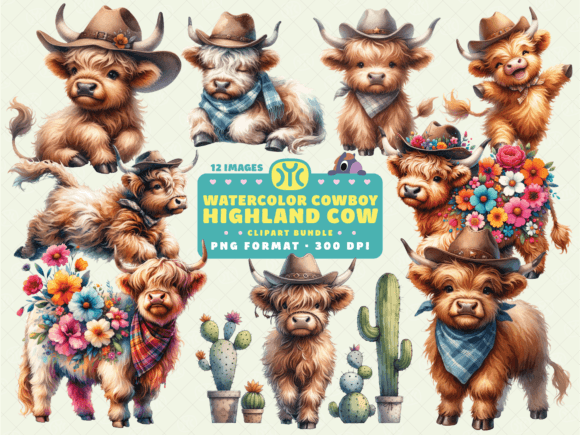
If you have spent any time browsing design assets for rustic, farmhouse, or western-themed projects, you have likely come across the Watercolor Cowboy Highland Cow Clipart set. This particular collection has carved out a loyal following among designers, small business owners, and crafters who need artwork that feels handcrafted rather than generic. Unlike stiff vector illustrations or overly polished stock art, this clipart captures the rugged personality of a Highland cow dressed in cowboy attire—complete with hat, bandana, or saddle details—all rendered in soft, unpredictable watercolor strokes.
What makes this clipart stand out is its balance between whimsy and authenticity. The Highland cow itself has a distinctive shaggy coat and long horns, and when combined with cowboy accessories, the result is a character that feels both playful and grounded. The watercolor technique adds texture, subtle color blending, and slight imperfections that make each element feel like a real painting rather than a digital creation. This is not clipart designed to blend into the background. It is meant to be noticed, to anchor a design with warmth and personality.
For the creative professional who is tired of overused farm animal vectors, the Watercolor Cowboy Highland Cow Clipart offers a fresh take on western iconography. It is equally at home on a wedding invitation for a barn venue, a logo for a craft brewery, or packaging for a small-batch hot sauce brand. The watercolor style communicates handmade quality, while the cowboy theme taps into a nostalgia for wide-open spaces, rodeo culture, and rustic simplicity.
Visual Characteristics and Design Appeal
The Watercolor Cowboy Highland Cow Clipart set typically includes multiple poses and accessories. A common layout shows the cow standing proudly with a cowboy hat tipped slightly to one side, a red bandana tied around its neck, and sometimes a lasso or saddle. The color palette leans toward earthy tones: warm browns, deep rusts, creamy off-whites, and muted grays for the cow's coat, with pops of red, turquoise, or denim blue for the accessories.
One of the strongest selling points of this clipart is how it handles texture. Watercolor naturally produces variations in opacity, edge softness, and pigment pooling. When these qualities are preserved in the digital files, the clipart retains a tactile, analog feel that contrasts nicely with the clean lines of modern typography. A serif font with sturdy slab details or a handwritten font with irregular strokes pairs well with this artwork because both share an organic, handcrafted ethos.
The scale of the clipart also matters. A single Highland cow element can work as a hero image on a poster or label, while smaller variations can serve as accent graphics on business cards, stickers, or social media tiles. Because the watercolor style does not rely on uniform edges, you can layer the clipart over textured backgrounds, kraft paper, or vintage wood patterns without the artwork looking pasted on. This adaptability makes the Watercolor Cowboy Highland Cow Clipart a versatile asset for both digital and print projects.
Where This Clipart Shines in Real Projects
I have seen this clipart used effectively across a surprisingly wide range of applications. Small business owners in the food and beverage industry tend to gravitate toward it for packaging design. A barbecue sauce label featuring a watercolor Highland cow in a cowboy hat immediately communicates smoky, bold flavors without needing a single word of copy. Similarly, coffee roasters with a western or ranch theme use the clipart on bag tags, tasting notes, and even canvas signage inside their cafes.
Event planners and wedding stationery designers also find value here. Rustic weddings, especially those held at ranches, farms, or barn venues, benefit from cohesive decoration assets. Save-the-dates, invitation suites, escort cards, and thank-you notes can carry a consistent visual thread when built around the Watercolor Cowboy Highland Cow Clipart. The key is to use the clipart sparingly—perhaps one large illustration on the main invitation and smaller silhouettes or accent elements on supporting pieces. Overloading a layout with too many large watercolor elements can overwhelm the text, so treat the clipart as a focal point rather than a repeating background pattern.
For digital content creators, social media graphics become more memorable when they incorporate distinctive artwork. Instagram posts, Pinterest pins, and Facebook covers for brands with a western, agricultural, or rustic lifestyle angle perform better when the imagery feels authentic and non-generic. The watercolor style stands out in a feed full of flat illustrations and stock photography. It also works well for seasonal promotions, such as fall harvest campaigns or rodeo-themed content.
Publishing and editorial is another area where this clipart earns its keep. Magazines covering rural living, homesteading, country music, or western fashion can use the clipart for article headers, pull quotes, or column dividers. It adds a hand-drawn charm that breaks up dense text blocks and reinforces the publication's niche identity. Even digital newsletters and PDF guides can benefit from a well-placed watercolor accent that gives the layout a finished, professional feel without requiring a full custom illustration budget.
How Clipart Influences Perception and Engagement
Design choices send signals to your audience before they read a single word. When you use Watercolor Cowboy Highland Cow Clipart, you are signaling approachability, craftsmanship, and a sense of place. The watercolor medium implies human effort and artistry, which builds trust and emotional connection. The cowboy theme adds storytelling potential—it suggests tradition, resilience, and a connection to the land. Combined, these qualities create a brand identity that feels personal rather than corporate.
Visual hierarchy also benefits from this type of clipart. Because the watercolor edges are soft and the shapes are organic, the artwork draws the eye without competing aggressively with text. In a layout where the headline is set in a bold display font and the body uses a clean sans serif font, the clipart occupies a different visual plane. It sits naturally in the background or as a complementary element, allowing the typography to remain readable. This is one reason why I often recommend pairing watercolor artwork with strong, simple fonts—let the clipart carry the personality and let the type carry the message.
Consistency across a brand's touchpoints improves recognition. Using the same clipart across a website header, product packaging, and email footer creates a cohesive visual thread. Over time, customers begin to associate the Highland cow character with the brand itself. This is a form of modern typography and visual branding strategy that works especially well for small businesses that cannot afford a full custom mascot design but still want a memorable identity.
Practical Tips for Choosing and Using This Clipart
Before purchasing a Watercolor Cowboy Highland Cow Clipart set, take time to evaluate your specific project needs. Not all clipart collections are created equal. Look for sets that include multiple files—PNG with transparent backgrounds is essential for digital use, while high-resolution JPEG or TIFF versions matter for print. Check the file sizes and DPI. If you plan to print on large format items like posters or banners, you need at least 300 DPI resolution. For web use, lower resolution is fine, but having the option to scale down from a high-quality source file gives you flexibility.
Pay close attention to the license agreement. Many clipart sets come with a standard commercial license that covers small-scale products like stickers, greeting cards, and digital downloads. However, if you intend to use the artwork for merchandise sold in large volumes, or if you plan to incorporate it into a logo that becomes the face of your brand, you may need an extended license. Read the terms carefully. Some artists restrict use in logo designs or require a separate usage fee for branding applications. The last thing you want is to build an entire product line around a design asset only to discover you do not have the legal rights to sell it.
When evaluating project fit, ask yourself a few questions. Does the clipart's color palette match your existing brand colors? Watercolor artwork often includes subtle variations, so look for sets that offer color flexibility or include multiple colorways. Does the style of the artwork align with your audience's expectations? A rustic, watercolor look works well for consumers who value handmade aesthetics and natural products. It may feel out of place for a tech startup or a modern minimalist brand. Be honest about the fit.
Font pairing is another consideration. This clipart pairs exceptionally well with script fonts that have a natural, flowing feel, as well as handwritten fonts that mimic casual lettering. For a more polished look, combine the clipart with a sturdy serif font such as a slab serif or a weathered wood type. Avoid pairing it with overly geometric or futuristic sans serif fonts—the clash between the organic artwork and rigid type can feel jarring. A good rule of thumb is to match the mood. If the clipart feels warm and rustic, choose fonts that carry similar warmth.
Finally, test the clipart in your actual layout before committing. Place it next to your headline, your body text, and any other design assets. Check readability. The watercolor style can sometimes introduce noise that distracts from small text if placed too close. Give the clipart breathing room. Use negative space around it so that it stands out as a deliberate accent rather than a messy overlay. Small adjustments in sizing and placement often make the difference between a professional-looking design and one that feels cluttered.
Final Recommendations for Creatives and Business Owners
The Watercolor Cowboy Highland Cow Clipart is not a one-size-fits-all solution, but for the right project, it delivers personality and emotional resonance that generic stock art cannot match. If you are working on a brand identity for a western-themed restaurant, a line of organic beef jerky, a country music blog, or a handcrafted soap company, this clipart can serve as a visual anchor that ties your entire look together.
My advice is to start small. Use the clipart on one product or one campaign first. See how your audience responds. Gauge whether the style connects with them or if it skews too niche. You can always expand usage later. And when you do commit, invest in a high-quality set from a reputable artist. Good watercolor artwork takes skill to create, and the difference between a well-executed set and a cheap imitation is immediately visible in print.
Ultimately, design assets like this clipart are tools. They work best when they serve a clear purpose within a larger visual strategy. By understanding the strengths and limitations of the Watercolor Cowboy Highland Cow Clipart, you can use it to create projects that feel intentional, professional, and genuinely engaging.